

The following is a continuation of Mera Peak Expedition — Acclimatization in Khare
 Friday, October 21
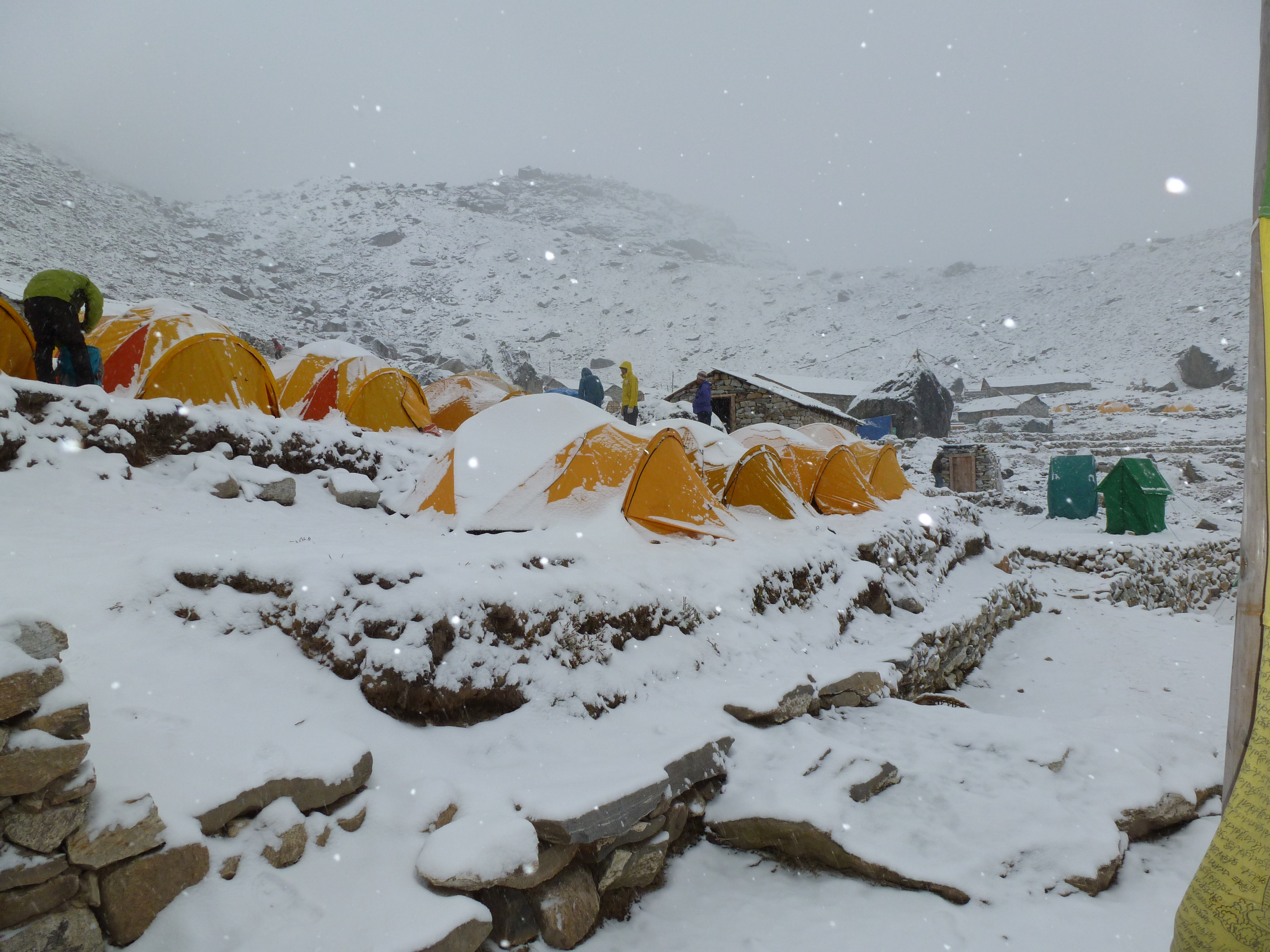
This was our day to head for High Camp, with Mera Peak summit planned for the following day. Not only did it snow that night, but it snowed enough that it appeared dark in our tent even after sunrise due to a thick layer of the white stuff. Slapping the tent roof and sides quickly revealed that it was morning and time to prepare for the highest hike of our lives.
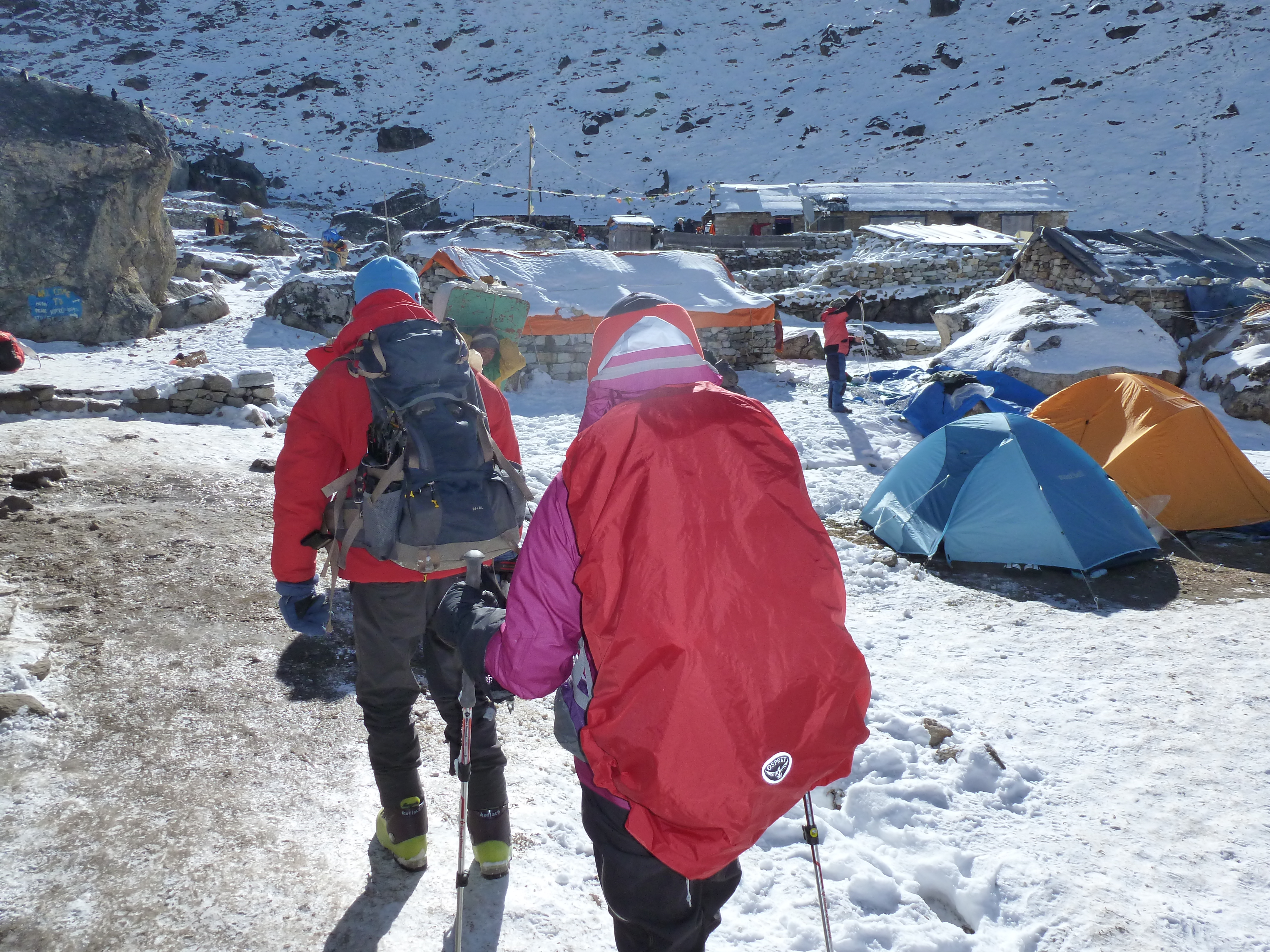
 We were surprised to learn that we would not be leaving any tents set up at Khare and that everything had to go into one of two duffel bags…one for the summit (already packed) and one for storage. Not a big problem, but something we hadn’t planned for. We also heard several avalanches during the night meaning that there might be a greater amount of snow at higher elevation. There was no way to know until we made our way up the mountain. This isn’t a place with radio communication, weather reports and the like. In Nepal, you find out when you get there or by asking others, but the answers when you ask are often confusing and contradictory…so you find out when you get there.
Being careful
We were very excited to go but needed to slow down and do the things that remained to get ready. We needed to make sure to eat enough breakfast, to double check that we had our gear and water and to know where to find everything quickly if needed. When we finally set off, it was about 9:30am and snowing fairly heavily. It was our hope that the snow would lift before we reached the more exposed Mera Glacier above Mera La (Mera Pass).
Starting up
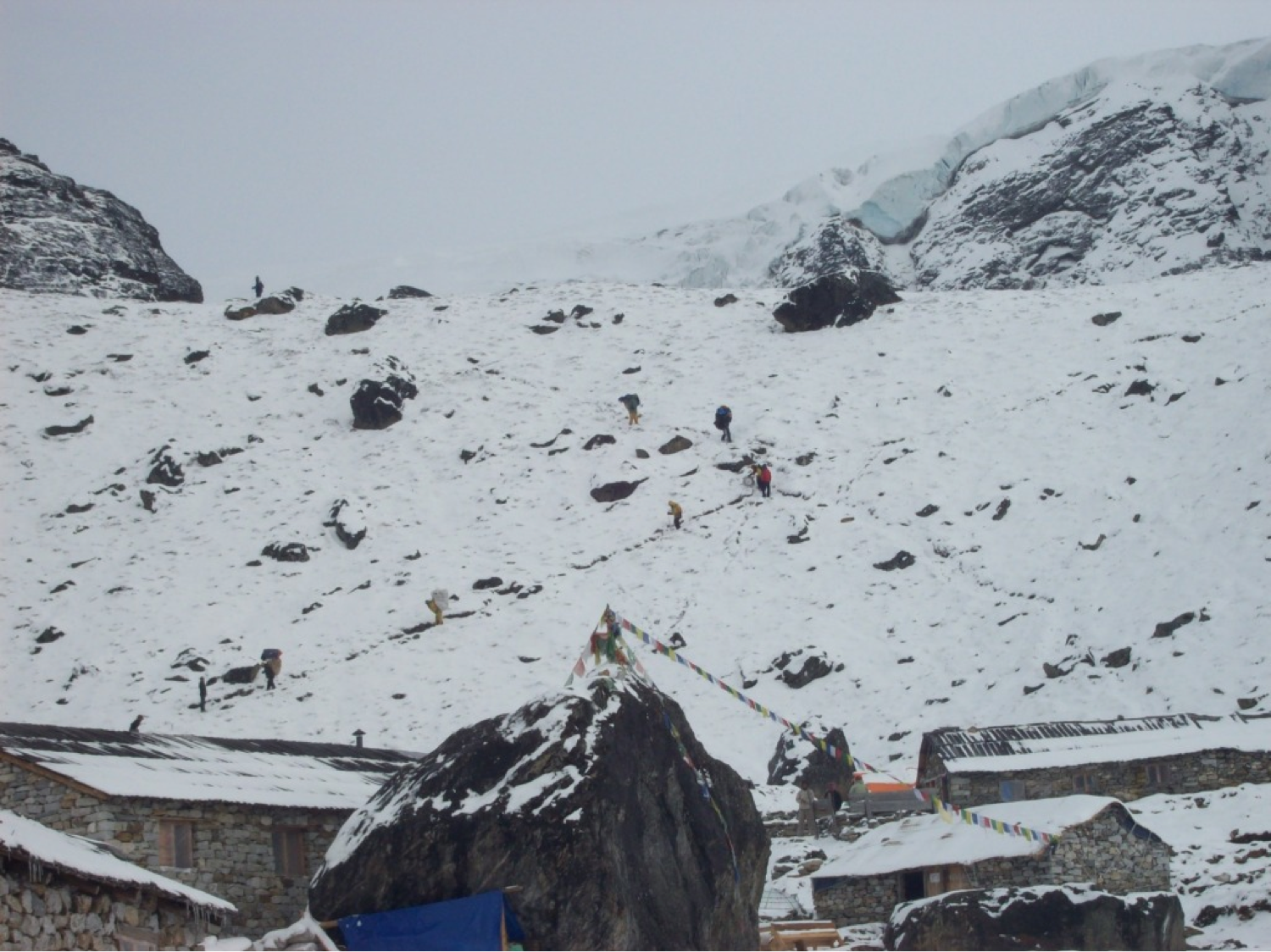 We started by climbing up the steep moraine slope just above Khare and were the only group headed up despite the late start. Once over the moraine, we could see that there were several more rocky slopes to go before the Glacier, and tackled each one slowly and deliberately. The going was slow as we went higher due to the steepness and the greater accumulation of snow, making the trail hard to find and causing our guide to cut steps at times with his ice axe.
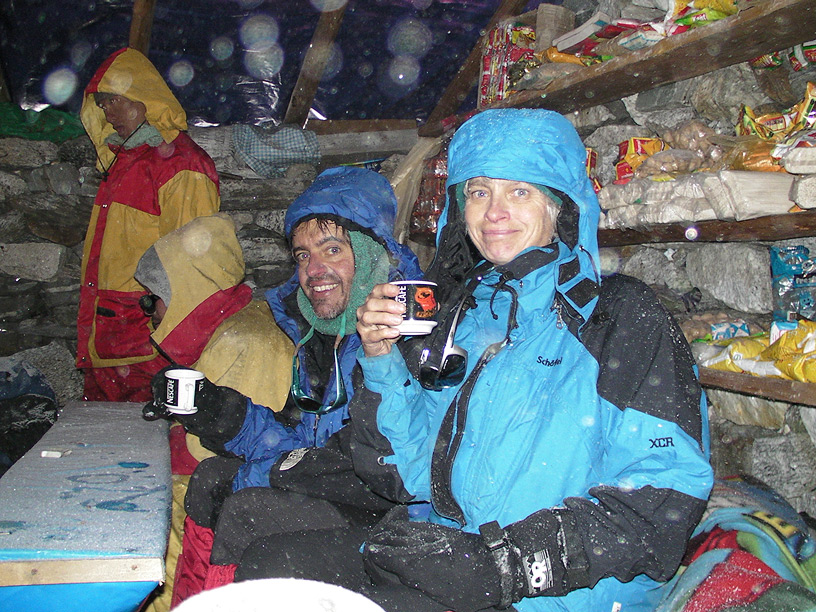 Our first stop was at a small hut that we came upon quite by surprise for the Westerners. We were able to have black tea, milk tea and coffee, which was very welcome as we’d reached a point where the wind whipped our faces and visibility was dropping.
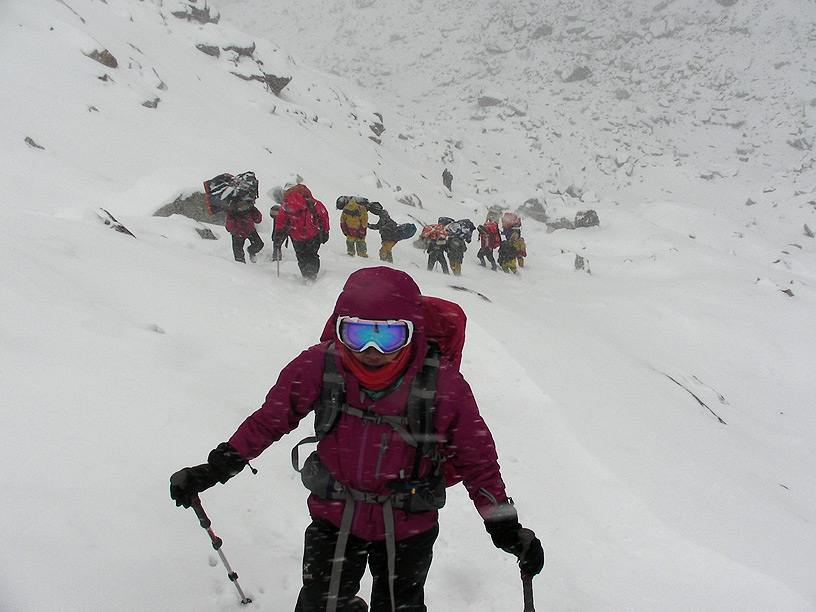 We continued to climb beyond the hut but by this point we were walking almost entirely in snow with far fewer rocks exposed, meaning the trail was completely covered and we needed to guess the best route. We soon reached the point where there were rock walls with enormous icicles and it was clear that we were coming upon the Pass.
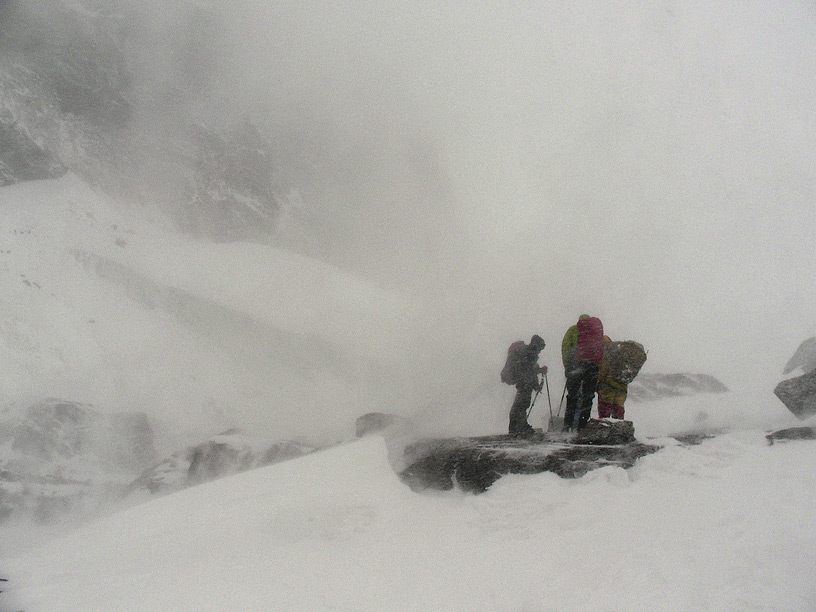 It was surprising to see that many of the porters didn’t have gloves, few had any type of pole or ice axe, and several had running shoes on their feet. They were beginning to slip and lose their balance, which was no surprise. When we stopped near the top of a particularly steep section, just at the beginning of the Glacier, we pulled out extra socks, gloves and even split up pairs of trekking poles so that they could continue on.
The decision
Just as we reached the Pass and the start of the Glacier, we met several sizable groups that were on their way down. The best way they could be described would be “refugees”. A group of three Norwegians described white-out conditions on a six-hour walk down from High Camp where the snow had accumulated to more than two meters.
They also described having to take turns digging out the tent throughout the night to keep it from collapsing. It was about then that we saw Subas “Dr Crevasse” Rai who had been set up the day before with tents to prepare for our arrival at High Camp. He looked frozen and it was easy to see why when we saw that he had only running shoes on his feet with cotton socks and a few thin layers of cotton under his waterproof jacket. He looked absolutely miserable but very glad to see us. (video courtesy of Joel Meyers)
Evacuating
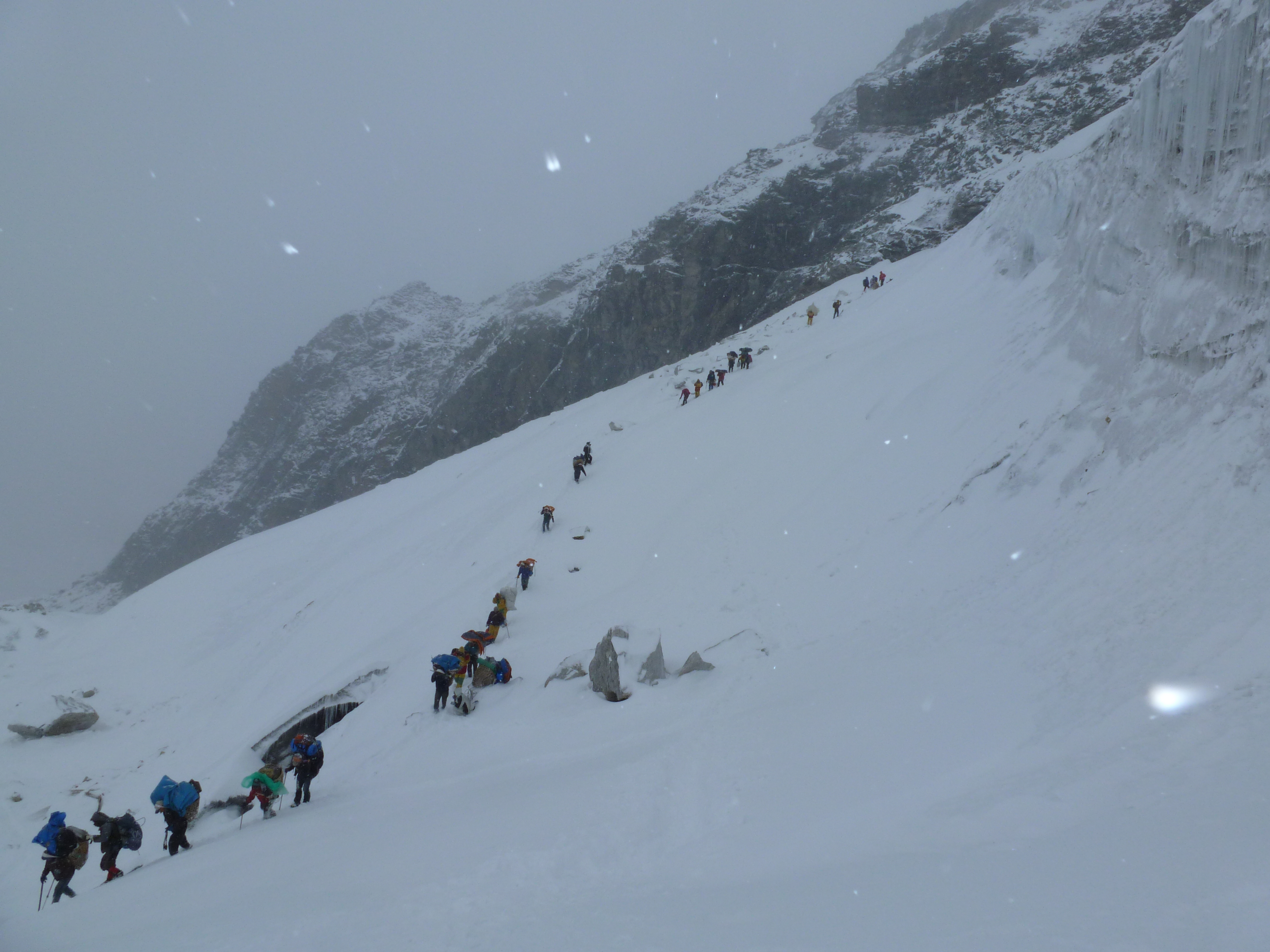 Our guides talked to the other groups’ guides and heard the same story we were hearing from Subas. The Mera Glacier had zero visibility and High Camp was uninhabitable. After only a few minutes of discussion, it was decided that we would need to return to Khare, and we all began a descent that involved seventy or so people of many nationalities but with the common challenge of terrible weather and frustrated plans.
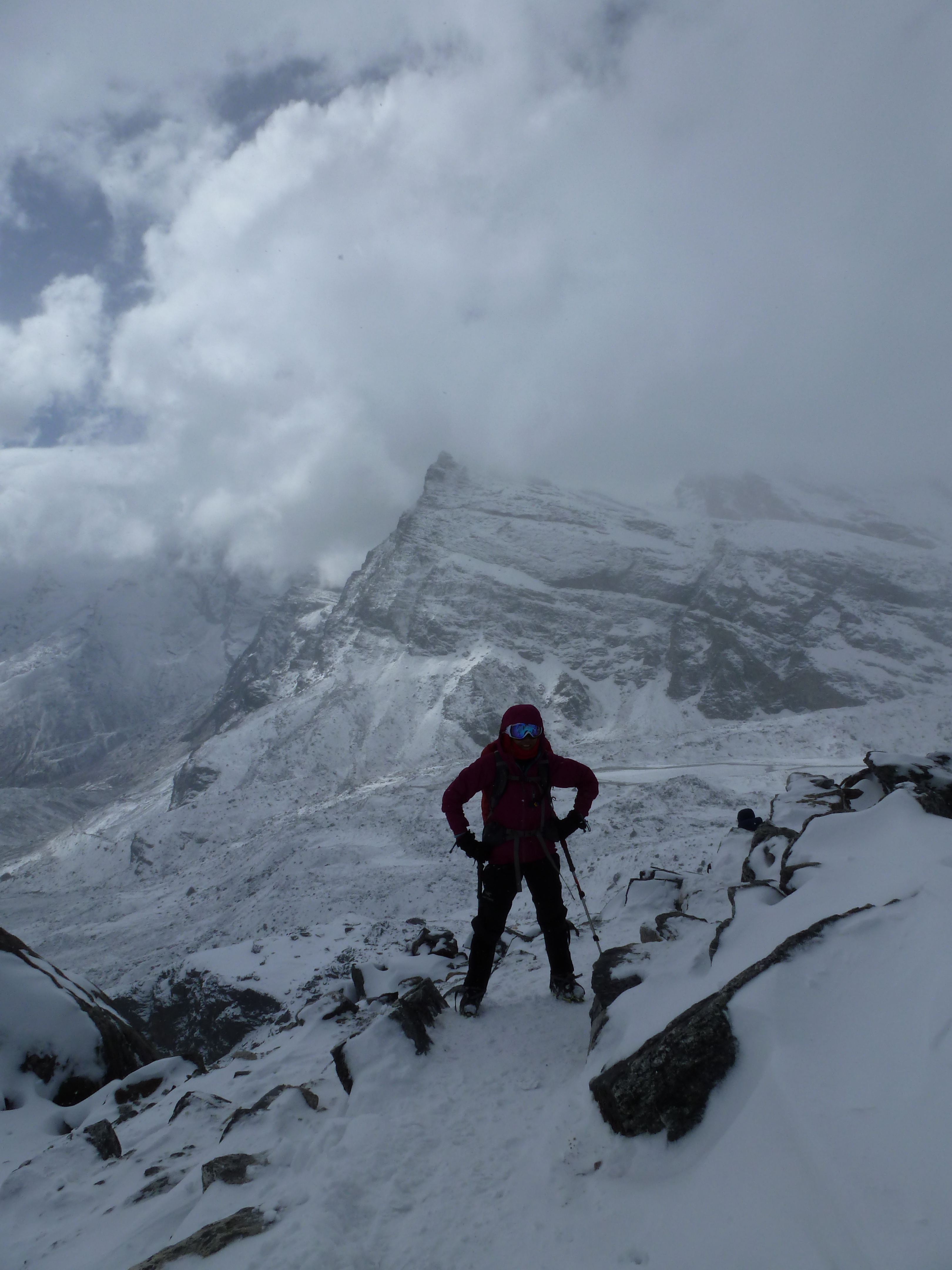 Going down was worse than going up as the track where people were walking was quickly becoming a packed ski slope where G-Star, Nike Air, and other smooth-bottom shoes were creating slick going. Jeanne and I made the decision to put on our crampons, which proved to be an excellent one, as we were the first down and without falling as so many others were. It was tricky enough to descend that some porters would simply let their loads go down the slope and then catch up after, and there were also porters who were dragging their load through the snow because it was far easier than trying to carry it.
A sunny day
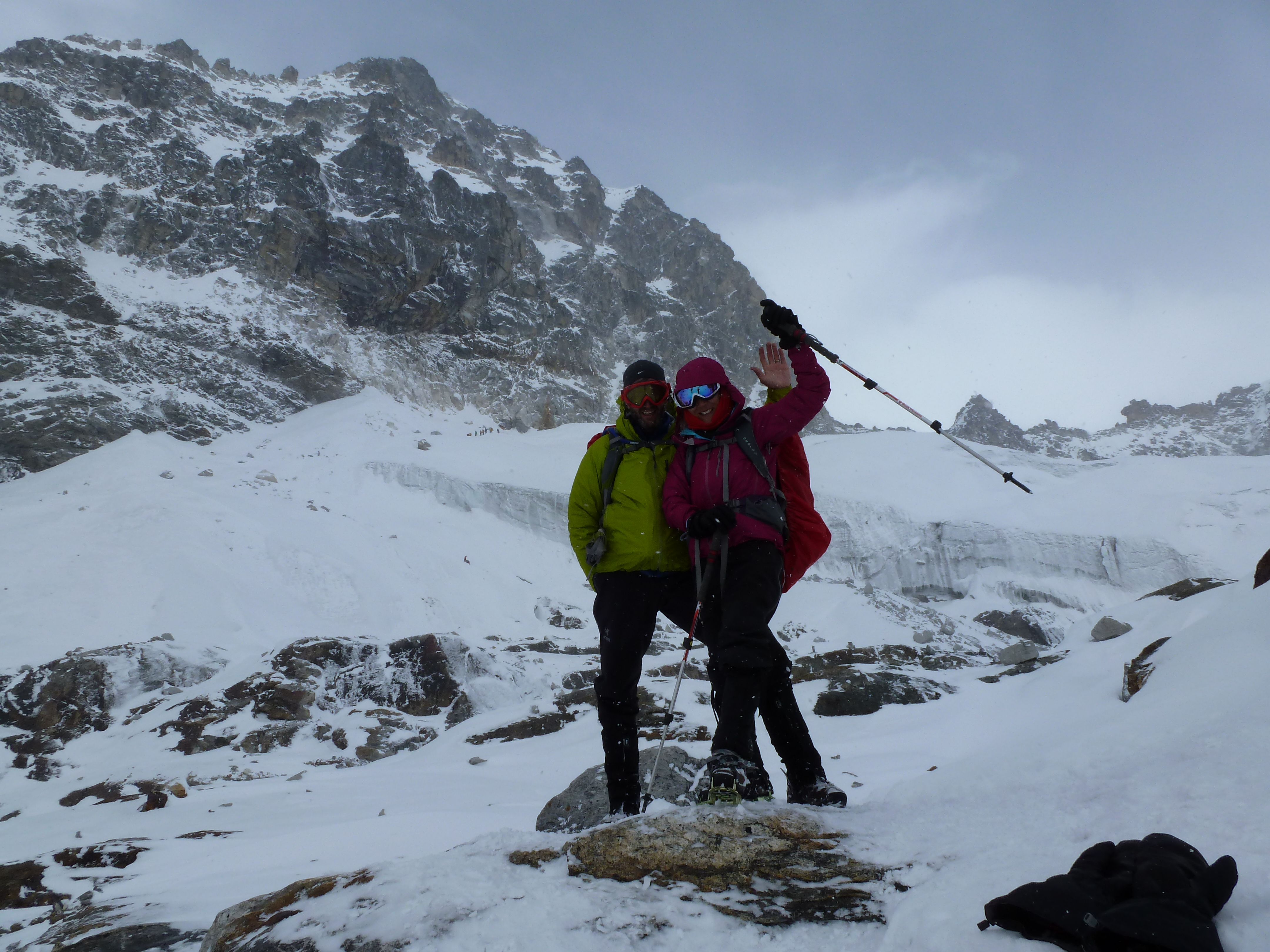 Before we reached Khare, the sun began to show itself through the clouds and the afternoon actually became sunny, much to our dismay. It isn’t clear if we would have been safe on the mountain and there was no indication that the sun would come out a short time earlier, but it was frustrating nonetheles. As the afternoon wore on, other groups showed up on Khare with stories of having to dig their tents out throughout the night until by morning their tent was essentially down in a snow hole. The poor weather created what was essentially a no-room-at-the-inn in Khare as the small village filled up with people coming down from High Camp, people coming down from an attempt to reach High Camp (like us) and people coming up the Valley from below. Nowhere would this be more evident than in the morning when everyone prepared to leave at the same time.
Tough night
The sky was completely clear this night and the temperature plummeted to the point that a headlamp in the tent revealed a fantasy scene of vapor crystals coating the ceiling and suspended in the air. We didn’t have a thermometer, but guessed that the temperature was likely below -10 Celsius. I was a very uncomfortable night as our 0 degree Fahrenheit sleeping bags were not enough to keep us warm once our hot water bottles cooled off.

Up next: Mera Peak Expedition — Going as high as possible on Mera Peak




 maximum adventure
Trackbacks/Pingbacks
[…] Up next: Mera Peak Expedition — Khare to Mera High Camp […]