

The following is a continuation of Mera Peak Expedition – Getting in and out of Kathmandu.

After our aborted attempt to fly to Phaplu from Kathmandu on Monday, we were able to successfully fly out at around noon on the 11th of October. The Tara Air plane was a small turbo prop that sat 19 people with two seats on one side and one on the other. The pilots were two young Nepalis who, like the other pilots we’ve seen, were well-dressed by Nepali standards and obviously enjoyed a career well above middle class in this country. Not a career without danger, however, as the same type of aircraft flown by a similar company crashed in a Kathmandu suburb near the airport just two weeks before, killing 19 people. It wasn’t pilot skill but weather that caused that crash, and this was thankfully a bright sunny day.
On to Phaplu
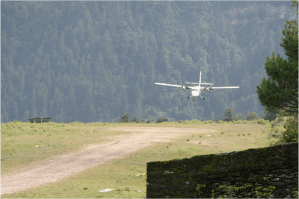
After hours of waiting in many different stages of departure from the Domestic Terminal, it seemed like a surprisinly quick taxi down the runway before taking off to the northeast. As we flew, we followed a ridge, gradually climbing to an altitude of 2700 m., at times no more than thirty meters above the tree tops. We sat in the very first row and saw the GPS constantly flashing either “terrain warning” or “terrain ahead” which are normally the warnings used to avoid collision with the mountain and NOT designed for steady-state flying. The flight was very smooth. Just before Phaplu, we made a turn to the north and entered a wide valley (by Nepal standards).
 Soon after and from some distance away, we saw the dirt strip and made a low pass to the right and parallel to the runway and the village of Phaplu before taking what was a course directly toward the tallest mountain. At the very last moment and with the GPS flashing a warnings again, we banked hard left and began a very fast descent to the air strip. The pilots left the flaps up until nearly touchdown so that they could maintain speed just in case they didn’t set down at the early enough and had to take off again. There was a mild bump as we touched the ground and we came to a very quick stop.
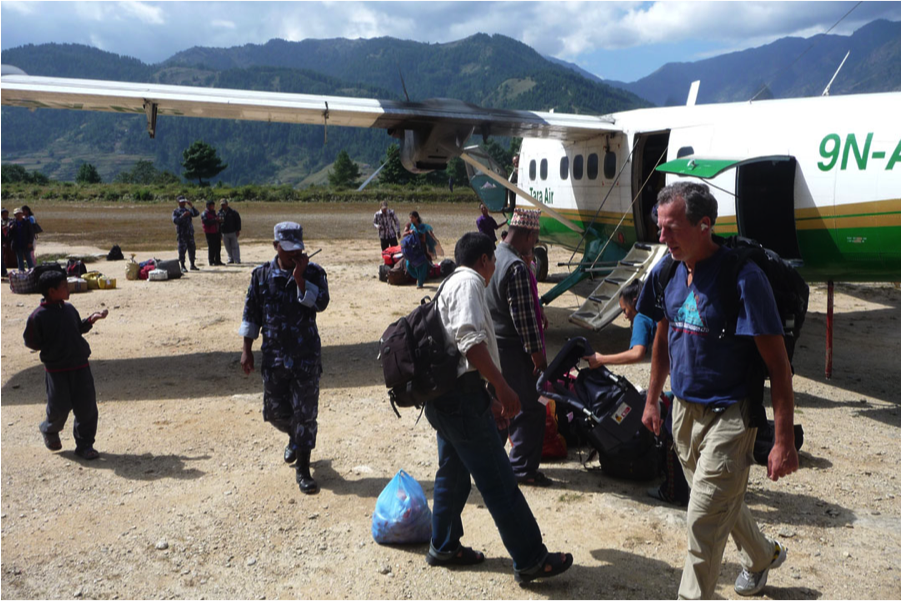
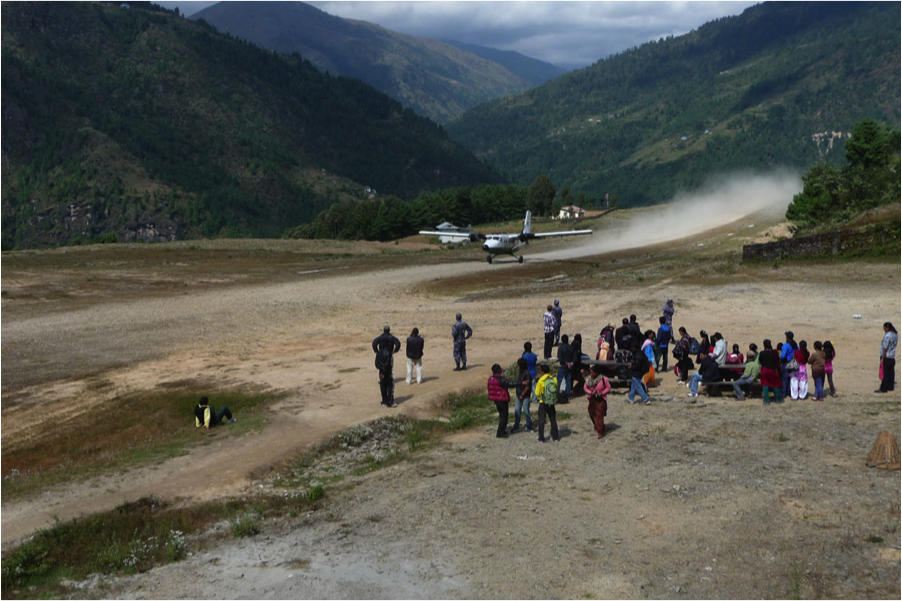 As we reached the offloading area (there was no terminal), there was a crowd of Nepali people and cargo awaiting our arrival. Even better, the ‘gate’ consisted of two wooden picnic tables. Within minutes, the aircraft was reloaded and taxiing back down the strip for takeoff. Before we left the short walk from the plane, it was taking off behind us. Curiously, the only ‘official’ presence was the single soldier monitoring the passengers and also manning the small gate in the chain link fence that allowed people to pass in and out of the ‘ramp’ area.
Our first activity after landing was to eat a lunch prepared by our staff that we had only been introduced to a few minutes before. Due to our delayed arrival, they had been waiting in Phaplu for two days for us (though they were in touch with our guides by cell phone). Typical for Nepal, we ate in a guesthouse even though the food was being prepared outdoors in the courtyard.
Trekking begins
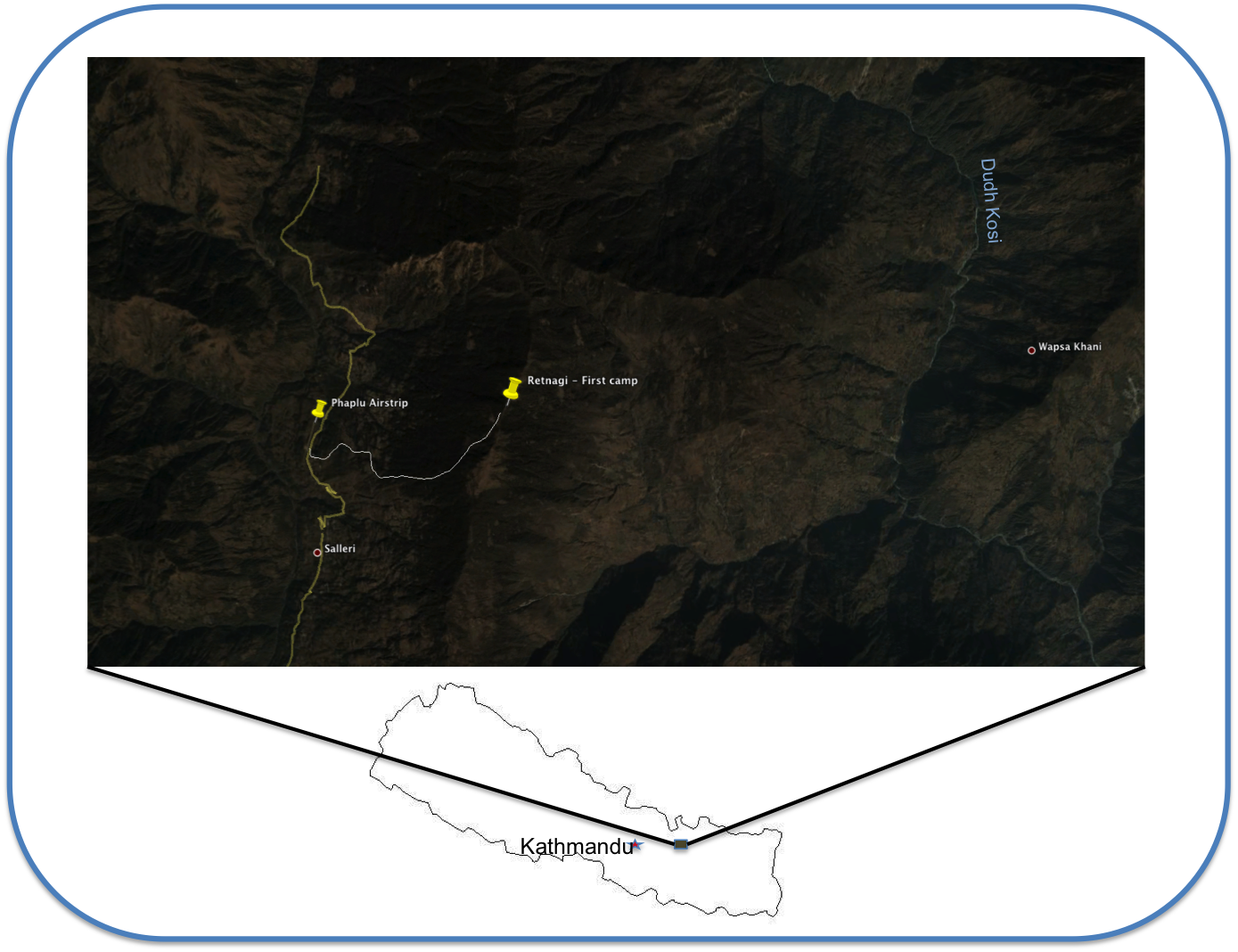
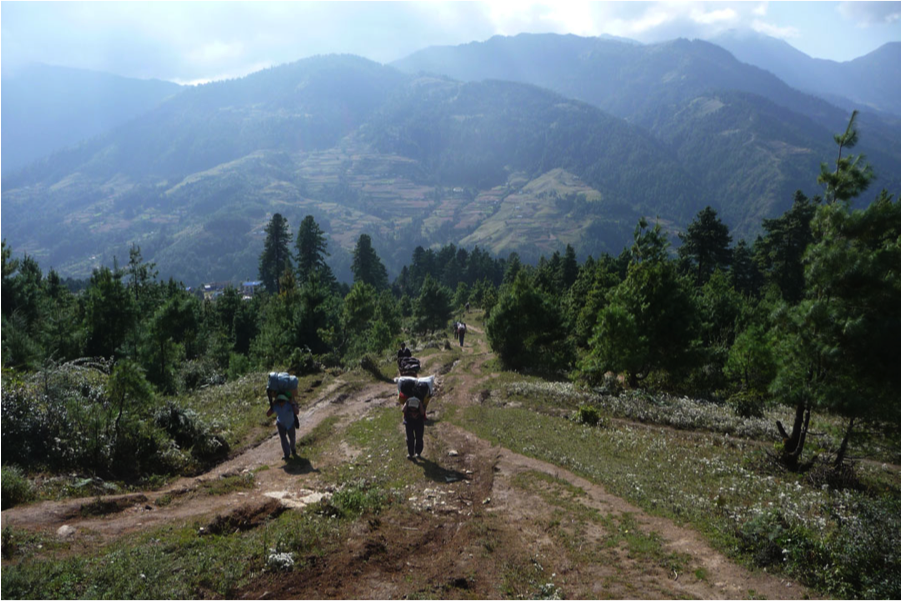 Once our lunch concluded, we hiked to the east for a few hours to the top of the 3,000 m. (about 10,000 ft) mountain above Phaplu, stopping at a place called Retnagi (meaning red, bare land, which was very accurate). This was our first campsite and provided us with a great view to the east of the Dudh Khosi, the main river of the Solukhumbu region that flows down from the Mt Everest drainage to the northeast. Through the clouds, we could clearly see snow covered peaks of the Himalaya in the distance, but what appeared to be lower peaks, not the 8,000 m. peaks we were eager to see. Within minutes of stopping, our tents were set up in a flurry of activity, and we were left to talk and relax before dinner.
Day’s end
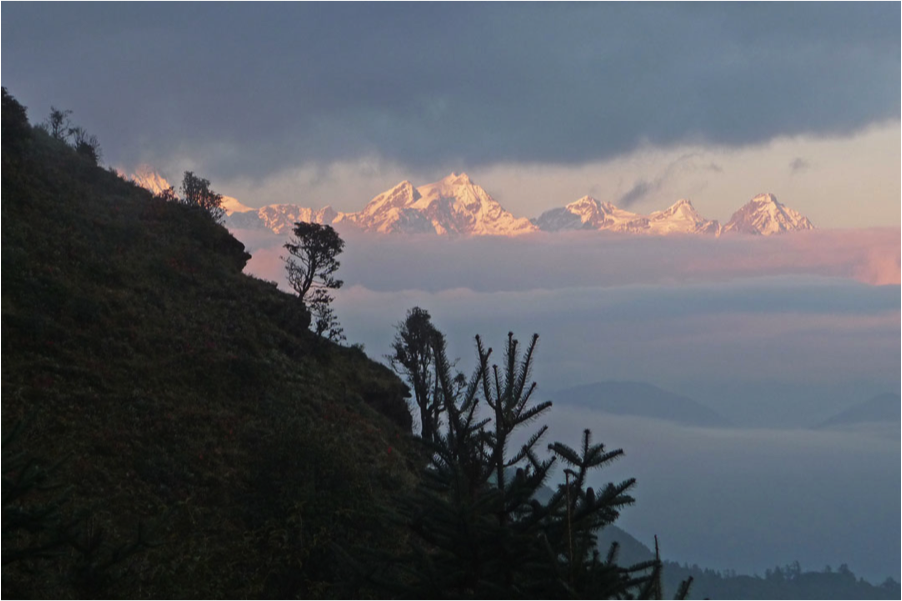 Dinner was a traditional one, with dal over rice. We were in our bright yellow and orange tents bed by 8pm for a 6am wakeup. Our plan for the next day was to walk to the relatively small home village of nearly all of our trekking support, Basa Village, located in a mostly Rai area along mountains lining the west side of the Dudh Khosi.
Our team
At the end of our first dinner, we were introduced to the kitchen staff, and they were as follows:
- Dilli Badhur “DB” Rai – Head Guide from Basa 6 (later nicknamed “Da Boss” or “Da Bomb”)
- Buddiraj Rai – Guide from Basa 6 and a good friend. He has his own blog found here.
- Purna Rai – Our head cook from Basa 8. Purna turned out to be one of the most smiley and happy people we’ve ever met.
- Ganesh Rai – Cooking Staff from Basa 8 (later nicknamed “Super Ganesh” for his speed and strength)
- Krishna Rai – Cooking Staff from Basa 8. Quiet and very friendly.
- Sai Badur Rai – Cooking Staff from Basa 8 (later nicknamed “Tokyo Joe” due to his Japanese appearance)
- Makkar Rai – Cooking staff from Basa 8 (later nicknamed “Happy Makkar” for his constant smile)
- Subas Rai – Assistant Guide from Basa 6 (later nicknamed “Dr Crevasse” for reasons I can’t quite explain)
We also were able to meet our porter staff of 16 Nepalis ranging in age from late teens to middle age. They were as follows:
- Dinesh Rai – Porter from Basa 8 (later nicknamed “Sundar Kopal” or “beautiful hair” in Nepali due to his long hair)
- Sam Bahktar Rai – Porter from Basa 8 (brother of Ramprasat Rai, our cook from last year)
- Shaibahdur Rai – Porter from Basa 8
- Padam Rai – Porter from Basa 6 (later nicknamed “Padam Hussein” just because it was easy to remember)
- Tsuje Bika – Porter from Basa 8 (Bika caste) (later nicknamed “Spiderman” due to his hat)
- Gopal Bika – Porter from Basa 8 (Bika caste) (later nicknamed “Rockford” due to his similar features to a young James Garner)
- Dil Bahdur Rai – Porter from Basa 6
- Purna Rai – Porter from Basa 6 (later nicknamed “Purna Dhoey” because he had the same name as the expedition’s cook)
- Dim Bahdur Rai – Porter from Basa 6
- Dipak Rai – Porter from Basa 6
- Bahkta Bahdur Rai – Porter from Basa 6
- Prakas Rai – Porter from Basa 6
- Kubir Dhan Rai – Porter from Basa 6 (later nicknamed “Bizsso” or “wrestler” in Nepali due to his sizable body for a Rai)
- Katga Bahdur Rai – Porter from Basa 6
- Yuba Raj Rai – Porter from Waku 3
- Naran Magar – Porter from Adheri/Basa 9, added when another porter injured his knee on the first day out of Basa (later nicknamed “Naranja” or “orange” in Spanish just to remember his name)
Up next: Mera Peak Expedition – Arriving in Basa




 maximum adventure
November 9, 2011 at 2:09 am
Mr Taylor, thanks for an exclusive presentation of your trekking. Seems like you love Nepal dearly. Hope you’ll be visiting Nepal year on year for yet more trekkings; there are thousands of routes though not well maintained.