

 We leave for Nepal in a few short weeks to climb a peak in the Sagarmatha Region of Nepal. Mera Peak is 6,476 m (21,247 ft) and while it is called a trekking peak and not a climbing peak, it wasn’t summitted until 1953, the same year as Mt Everest. To go that high means being prepared in new ways when it comes to equipment, clothing and fitness. We’ve had nearly a year to get ready, and here’s what we’ve done.
Acclimatization
Nothing will keep us from the top more than acclimatization and our fitness level. The acclimatization has to occur once we’re in Nepal and en route, as we live only 300 m (1000 ft) above sea level. Our last six months included:
- Mt Shuksan, Washington took us to 2783 m (9131 ft)
- New Army Pass, California took us to 3749 m (12,400 ft)
- Mt Whitney, California took us to 4421 m (14,505 ft)
- Rupina La, Nepal took us to 4643 m (15,232 ft)
These adventures were still far below where we’ll be going, so the only way to truly be prepared is to work on the things that can be done…strength, endurance and mental toughness.
Physical fitness
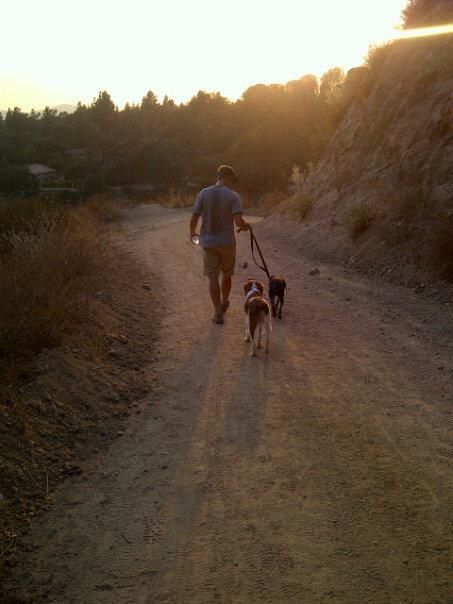 People put a great deal of focus on physical fitness and they should. If you aren’t fit, you will suffer from the problems that unfit people encounter when they push beyond their readiness…knee and back issues, muscle tears, cramps, stiffness, and blisters. There’s no substitute for getting out on the trail and putting in the kilometers.
Mental fitness
If you aren’t ready mentally as well, you won’t be able to tough it out when you reach the hardest parts. You may quit or worse, convince others to quit. Being mentally tough is the hardest preparation of all because you can only get there by pushing yourself beyond what feels comfortable and easy. How do you get mentally tough? If the trail is easy, go fast. If the trail is hard, go as fast as you can until your body makes you stop. Mental toughness is the reason the best riders in the Tour de France aren’t the 20-year-olds. Some of the best marathoners are in their 30’s and 40’s because the mental challenge is greater than the physical, and this takes time to develop.
Technical gear
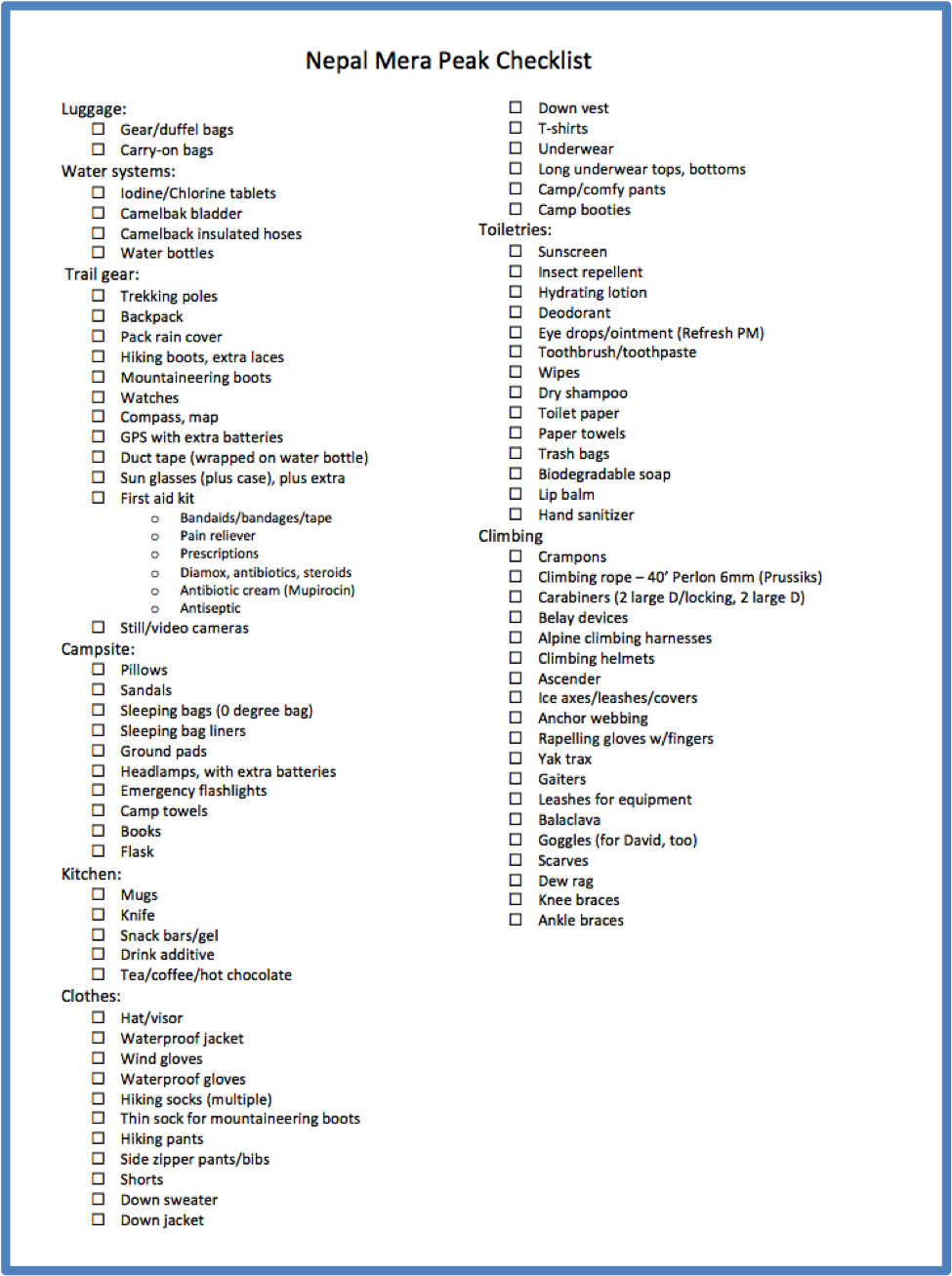 People spend a fortune on technical gear and undoubtedly more than is necessary. We have things we bring for climbing, like harnesses, ropes and ascenders, but also things we bring for convenience, like lightweight binoculars and a good camera. We’ve developed a Mera Peak Checklist just for these items as forgetting something could be at a minimum, disappointing, and at a maximum, unsafe.
Clothing
 Having the right clothing that allows a trekker to be in many climates within the span of a few weeks isn’t a simple matter. We are big believers in layering clothing so that every item has multiple uses and the ultimate effect is to have less weight to carry and much more flexibility. Anything that can be rolled, stuffed or folded into a small space needs very careful consideration.
- First layer – Merino wool long underwear. Thin and useful in a broad range of temperatures. Doesn’t hold smells very well since it is a natural material. Wicks moisture away from your skin so you don’t feel wet when you sweat.
- Optional long underwear – We have varying layers for wearing over the first layer as the temperature drops. Patagonia has a great system for labeling their long underwear by 1, 2, 3, and 4, with 4 being the thickest/warmest.
- Warmth layer – When cold weather calls for more clothing, the layer above long underwear can be down. Warm, but not waterproof in our case, so we have another layer after that.
- Waterproof layer – We both have the Patagonia M10 shells that are extremely breathable but also waterproof. This layer can be worn directly on the skin when you have warm rains down low, or over the down and long underwear when you are in frigid temperatures up high.
These four layers provide incredible flexibility for changing conditions, even within a day. It is a sort of ‘clothing system’ that makes hiking and trekking much comfortable. Heavy jackets and thick clothing in general aren’t useful as they don’t have a broad range of use, aren’t part of a ‘system’ like we describe, and take forever to dry if they get wet.
Footwear
This topic is well-covered in a recent post Why footwear matters so darn much.
Travel and its challenges
All the gear and fitness won’t make a difference if you aren’t ready to travel to your destination. We have gear bags that we check for air travel, and we have our essentials like passports, wallets and medication in our carry-on bags and never in checked luggage. We travel often and so it isn’t a difficult exercise for us. A part of the challenge is to have a great attitude and to be flexible when plans change unexpectedly. Every change is an opportunity to find an unexpected adventure, so when it happens, roll with it.




 maximum adventure
Trackbacks/Pingbacks
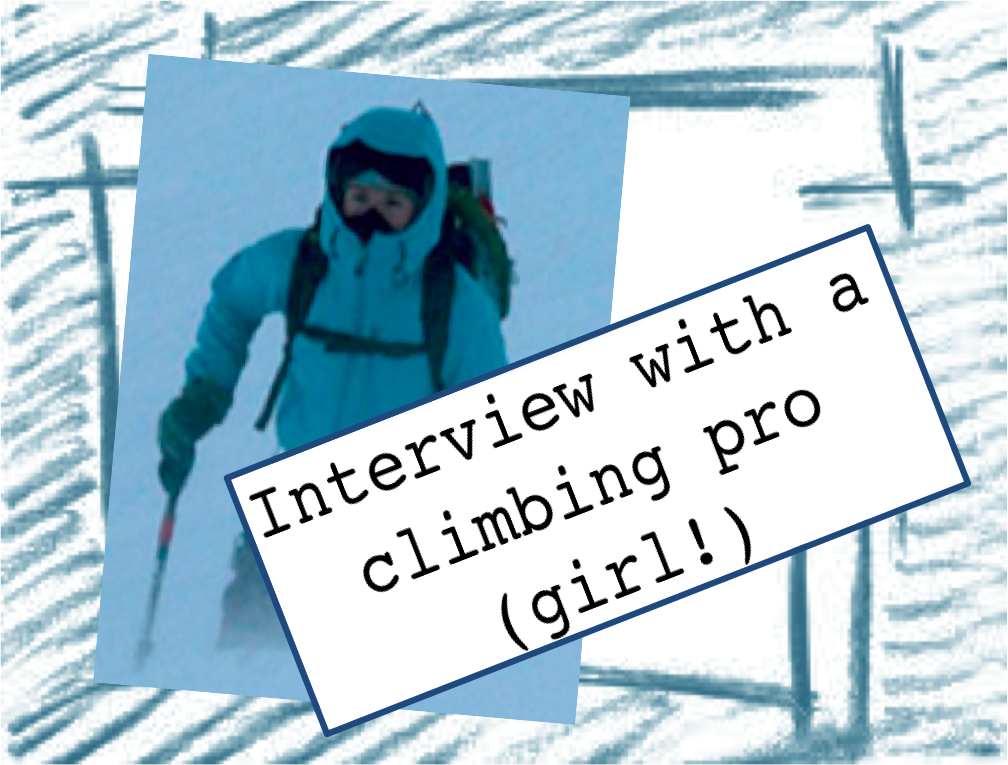
[…] as Melissa Arnot, world-class climber and mountain guide with First Ascent. As I stress to prepare our climb of Mera Peak, Nepal (6476 m) over the next three weeks, I find support from other women that help me to know I can do […]