

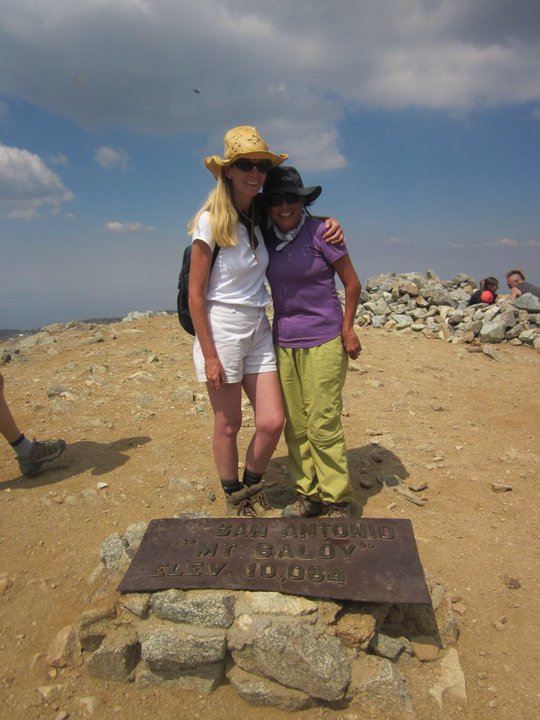
 On July 19, 2010, the message was posted on the Baldy for the Blind website, “Mt. Baldy was a success!!” The dream of reaching the summit of Mt Baldy, the 3248 m (10,068 ft) peak that dominates the the horizon to the southeast of the City of Los Angeles had been realized for a group of eight blind students, sixteen sight guides, and one leader, Chris Lynch, of the LA Meet-Up hiking group.
One member of the group, Melissa Hudson, is a friend of ours and an inspiration to us as she goes through life with what could be considered a significant disability, but for her is just another challenge to overcome. Not only does Melissa work through the challenges of not having sight, but she was diagnosed at 3 years old with Juvenile Rheumatoid Arthritis, the initial challenge that led to blindness and attacks the cartilage in her joints, even her feet and knees. Quite a lady.
Chris’ perspective
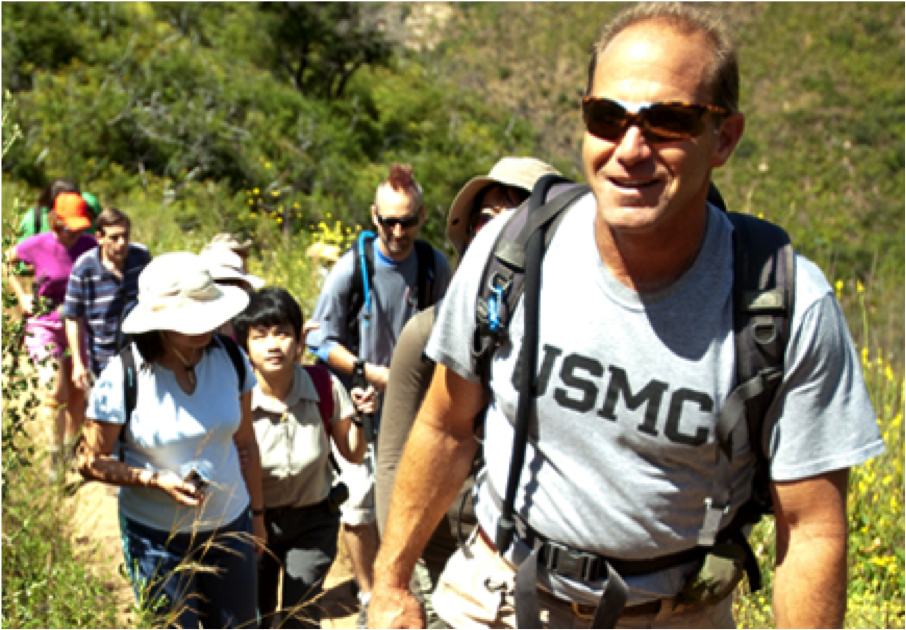 This dream started in the head of Chris Lynch, a writer based in Los Angeles. His own journey started when he joined the Meetup LA hiking group in Los Angeles four years ago as a way to prepare for a planned climb of Mt Kilimanjaro. As he saw some of the slower hikers getting discouraged by the fast pace of the younger and faster people, Chris decided to start a series of hikes he called “Slow-poke to the Summit” with the first climb to the summit of Mt Baldy. He’s now taken about 60 people to the summit…60 people who never thought they could get there.
Chris found helping people to push the envelope to be thrilling. This led him to the Braille Institute and the idea of taking blind students to the top of Mt Baldy. The first meeting gained twenty signups, which was pared down to two groups of seven, but finally became a core group of eight who achieved the summit. Starting four months before, they began a series of hikes with the blind students using his Meetup group members as the guides. First, there was a great deal of practice around how to lead the sight impaired, then gradually increasing distances and elevation changes…first 3 miles and 300 feet at Chantry Flats and then had hikes of increasing difficulty and length over the next four months. As Chris tells it, he realized that this was really likely to happen when the group successfully hiked Ice House Canyon to the Ice House Saddle (from 4,900 ft to 7,555 ft over 7 miles), then Mt Baden Powell (from 6,593 ft to 9,399 ft over 8 miles). Chris says, “On these hikes, even those who had a tough time made it, and keep in mind that some of the students were older and blindness was only one thing to overcome.”
Chris is very humble about his role in the climb and points out, “”I rarely led anyone or had anyone holding onto me because the sighted guides were doing it.” He adds, “I was the experienced person who knew the trails, knew first aid, etc…but the people who did the yeoman work were the sighted guides.”
The unexpected
When you ask Melissa or Chris what the biggest initial challenge was, they won’t say fitness or desire. It was transportation. The first time they met for practice was at the Braille Institute in Los Angeles and it was quickly apparent that getting so many people, including those reliant on others for transportation, to meet far from the day’s objective wasn’t going to work. Chris thought about the problem before pairing people up based on geography. It worked. Not only would the sight guides help on the trail, they would also make sure that everyone arrived in the first place. As Chris puts it, “There were days when there were people hanging onto your arm for ten hours and then had to be driven home.”
Melissa’s perspective
 For Melissa, the hardest part was a section called, “The Devil’s Backbone.” This is a narrow section that follows a ridge top, with one side dropping toward Los Angeles, and the other toward the High Desert to the east. Just before this section, Chris Lynch stopped the group and let them know that he had done this part blindfolded with a sighted guide just to know how to help others through it. Those words were meant to be reassuring, but in Melissa’s case, caused her to be afraid and think seriously about heading back down. She didn’t, however, and to this day considers that one of the many things she overcame through this event.
Melissa credits Chris with starting small, with manageable distances and terrain so that people thinking, “I can’t do this,” would learn to press through their fears. He also gave advice on how to be prepared with the right shoes, trekking poles and backpacks for the trip.
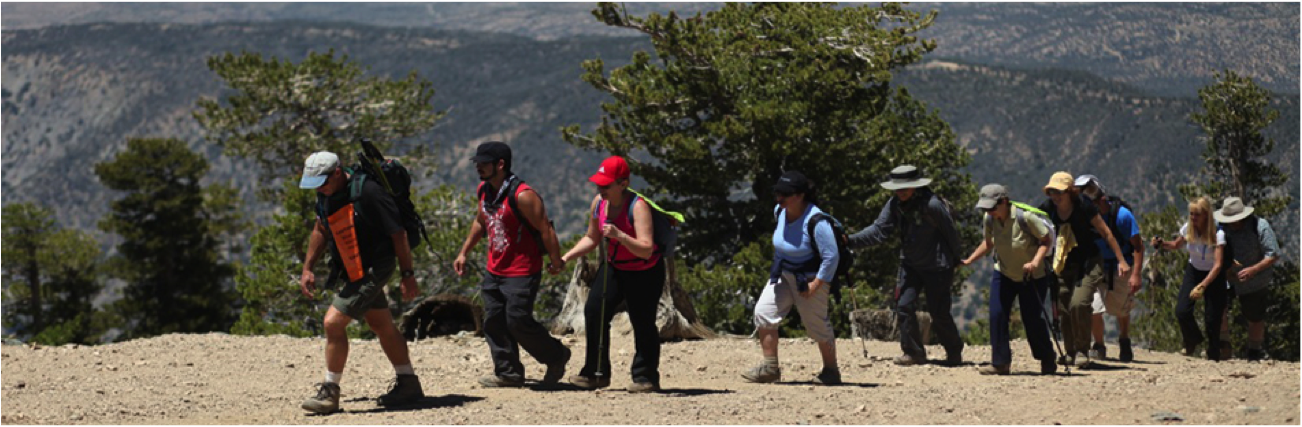 When asked why she decided to do this, Melissa says, “I decided to go because of my husband, David. He started hiking as a fitness program and became friends with many other hikers. I decided to see what hiking was about so that I wouldn’t feel like an outsider.” She had difficulties in getting started, but soon realized that “everyone else is blind, too.” It became easier when she knew she wasn’t alone and blindness was no longer her challenge.
 When asked the question, “What did you learn from this?” Melissa responds, “I learned that I can do more than I thought. Mentally, we put barriers on ourselves. Along the way, we possibly taught the sighted people more than they taught us by teaching them that we’re everyday people who have more things in common than they thought. Hiking is also more mental than people think, as it becomes, ‘one foot in front of the other’ on the way to the top.”
Melissa has a guide dog, Anya, but didn’t take her along for this adventure. Melissa explains, “While it isn’t impossible to bring a guide dog, it is hard for the guide dogs to decide how to find the safest path. It is confusing for the dogs that are trained to get around obstacles when the whole path is made up of obstacles.”
First Annual Mutt Strut
 Anya will be guiding Melissa at the First Annual Mutt Strut in Los Angeles, CA on September 10, 2011. The Mutt Strut is sponsored by the California Council of the Blind and Melissa is the chairperson for the Los Angeles event. The Mutt Strut is being put on to raise awareness of the CCB, an advocacy group for blind and visually impaired. Melissa points out that it is “of” the blind and not “for” the blind, meaning CCB isn’t made up of sighted people helping blind or visually impaired people; it is CCB made up of blind people. Advocacy is their mission, and as an example, CCB was key in getting ‘talking ATMs’ started in California and then at a national level.
Beyond advocacy, CCB has scholarships for vocational or graduate schools, crisis intervention funds for people going through tough times, especially with all of the funding cuts happening due to overstretched budgets. They help people who are going blind and match people up with other groups that can help, such as Guide Dogs for the Blind.
The movie
A story this interesting needs to be told, and there is a movie in the works that was started before the climb. At the website for Baldy for the Blind, you can read the following:
“Baldy for the Blind is the story of 11 blind students attempting to summit the highest peak in Los Angeles County. Boasting a height of 10,068 feet, Mt. Baldy is the ultimate challenge for this extraordinary group. The film showcases their expedition into great heights, featuring their varying levels of visual impairment, diversity, and remarkable desire to realize their goals. Led by mountaineer Chris Lynch, the students experienced a series of seven training hikes over a total of four months, preparing them for one of the biggest achievements of their lives.”
Erik Weihenmayer
Erik Weihenmayer has been an inspiration for many people, both blind and sighted, as the first blind person to climb Mt Everest and the only blind person to climb the World’s Seven Summits. He was most recently a competitor on the program, “Expedition Impossible.”
Erik created a video message for the group that Chris Lynch played on his laptop at the Mt Baldy Lodge. Knowing that someone as inspirational as Erik was aware of their attempt was a significant morale booster for a group out to meet their own challenge. In the video, Erik told them that he was following the groups progress and urged them to reach the summit and conquer their own doubts and fears.
The best description of what Melissa and the others are doing is found in the description of the documentary, “a film about summiting your own mountains.” They are an inspiration for anyone who wants to accomplish the seemingly impossible.




 maximum adventure
August 27, 2011 at 11:28 pm
Awesome! I love this story. It confronts all of us who make silly excuses for why we don’t do things that require a lot less courage.
August 27, 2011 at 11:36 pm
Yes, indeed. We need to push our limits every day.
August 28, 2011 at 4:13 pm
Inspiring!
August 28, 2011 at 4:33 pm
I was so proud of Melissa and so happy to guide her on her first Baldy for the Blind training hike! She truly inspired me. When I was hiking to Everest Base Camp I kept telling myself – if Melissa can do Baldy, I can do this! – Kate Stewart
August 28, 2011 at 4:54 pm
She is a remarkable person…they all are!
August 28, 2011 at 11:20 pm
I’m also proud to be one of the blind hikers who made it to the top of Mount Baldy with my fellow hiker Melissa!
August 28, 2011 at 11:29 pm
Jojo, thank you for your comment! And congrats! You guys ROCK!
August 29, 2011 at 5:16 pm
Wow! As always Melissa is an inspiration to us all!!! Absolutely terrific!!
Thanks so much for sharing the story, Chris