

This post is a continuation of Arriving in Kathmandu, Nepal, April 2010.
Going trekking
 Few experiences in our lives compare to spending two days trying to fly out of the Kathmandu domestic air terminal. Our destination was Tumlingtar, east of Kathmandu and south of Mt Everest, but weather conditions both days were hot and humid, closing most of the airports at lower elevations due to wind and thunderstorms. We had no idea of this as we left from our hotel in Kathmandu on a clear, cool morning. Our plan was to trek the Arun Valley from the foothills to the Himalayas, with hopefully clear views of Mt Everest.
Domestic flying
The first thing notable about the domestic side of the airport was the very long lines of guides and trekkers that had formed by the time we arrived. Everyone had large duffel bags, just like we did, and there were piles of blue bags, piles of orange bags, but everywhere guides, trekkers and bags. When the doors finally opened, however, the long, orderly line became a contest to see who could talk their way to the front and inside the terminal.
 Immediately inside the door was the typical luggage and walk-through scanners that you’ll find anywhere in the world, except these had seen better days and we suspected were purchased second-hand at the security equipment auction (if there is such a thing). To emphasize the point, the baggage scanner didn’t have a functioning belt to move the luggage through, and so it was the job of a nepal police officer to reach into the machine from the far end with wooden pole that had a hook on the end that would allow him to pull the bags through. It was one of the first many ways we would see Nepalis make up for technology with human labor.
Even more surprising a a bit alarming, people were milling about near the machines, making it impossible to know who was entering, who was leaving, and who or what was being security checked. We eventually made it inside where stood near the Agni Airlines desk and waited while our guide, Buddi Rai, working for Adventure Geo Treks, appeared to be negotiating with the airline workers. We didn’t pay separately for tickets, and to this day, it is unclear to us how the reservations and ticketing system works. There were black and white monitors on the walls, but the screens were blank and it wasn’t clear if anything displayed would be a comfort or anxiety-producing, as the noise and apparent lack of order in the terminal kept us from knowing what to expect next. Loud, indistinct announcements were made periodically in what could have been English, or Nepali, or Swahili…we couldn’t know as the PA system was as modern and functional as everything else.
Entering the departure lounge meant separating into male and female lines, and then passing through a small, curtained room, where a single policeman/woman did a quick frisk. As we found out later, if you had to come back through for any reason, you simply say, “I was already checked,” to which the always-polite Nepalis would say, “OK, yes,” and allow us to pass through unimpeded by another frisk. Even if the official was a different one…
We spent an entire day this way, trying to get updates from staff, being told our flight was not canceled but only delayed. Late in the afternoon we finally were told the flight was canceled and to come back the next day. We did just that, only to find the same situation the following day. It was still the weather in Tumlingtar, and it was still a struggle to get answers, until in one moment Buddi came over to tell us that we needed to urgently go to the gate, and that we were approved to take off. We hustled to the departure area, where we were once again separated into security lines by gender and then loaded onto a bus bound for the plane. Once at the very small turboprop, we waiting while the airline loaded a young boy on the plan who was returning home from surgery in Kathmandu. Just as he was settled on the plane, the pilot walked around from the other side of the plane and shouted, “What are you doing here? This flight is canceled!”
Change of plans
 Before this, back in the terminal, we asked Agni for a forecast for the next day for Tumlingtar and were told, “the same as today.” Something had to give. We approached Buddi and asked for alternative plans. He didn’t seem very surprised. He stepped off the bus, pulled out his cell phone, and called the trekking company to see what could be done. He returned a surprisingly short time later to offer us a 9-day trek in Langtang Valley, but with arrival at the highest village in the valley by helicopter. After two days of chaos, a 45-minute flight to the heart of the Himalayas sounded like a perfect plan.
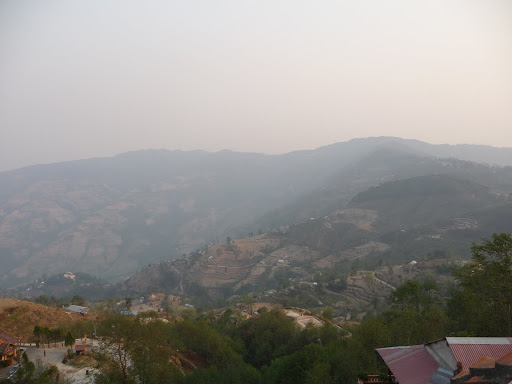 To make up for our loss of trekking time, we were also offered a chance to spend the night in a hilltop getaway not far from Kathmandu known as Nagarkot. It turned out to be a very pleasant, quiet area that seemed a world apart from the noise and density of Kathmandu. We walked around the resort property, bought a dusty, old map of Langtang Valley in a nearby store, and had a great dinner before going to bed early for our 4am drive back to the airport.
Helicopter flight
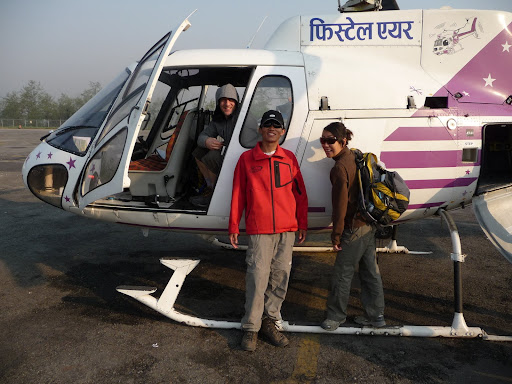 Travel by helicopter was an entirely different experience. Sure, we had the same security as the previous two days, but once through, we were taken directly to the aircraft and were boarded and in the air in a very short period of time. Our pilot was trained in Russia and Florida (an odd combination) and looked like a Nepali version of pilots everywhere with a green flight suit, a leather flight jacket and Ray Ban aviator sunglasses. After takeoff we Kathmandu and then two heavily terraced ridges before making a hard right turn into the opening of Langtang Valley. The valley floor rose quickly but the peaks rose even more quickly until we were well below the peaks of either side of the valley. The pitch of the helicopter blades also changed as the air grew thinner and we fought for altitude, quickly approaching the helicopter’s limits.
Kyangjing Gompa
 Before takeoff, we were warned that we would probably be too heavy to take all the way to Kyangjin Gompa, the highest village in the valley at 3,800 m. (12,467 ft.) and that we’d need to walk a couple of hours to meet our bags. As we approached, however, the weather and air conditions were favorable and our pilot was able to build up enough forward speed to trade for altitude and just bring us over the ledge on the shoulder of the mountain where the village clung to the mountainside, putting us down on the “H” formation of rocks in what turned out to be a yak pasture.
Rock stars
 Just before landing, we spotted enormous glaciers just above the village on the north wall of the valley on the side of Langtang Lirung, a 7227 m. (23,711 ft.) mountain that is the 99th tallest in the World. The crystal clear air in the morning sunlight made the white and blue shades of the glacier a National Geographic picture and our excitement was obvious. We landed like rock stars, all smiles, and were met by what seemed like the whole village. Three tall, blonde Westerners emerged from the crowd with duffel bags the same color as ours, and cross our path with slight nods as we headed toward the village. Our trek had begun, and in a glorious, unforgettable way.




 maximum adventure
Trackbacks/Pingbacks
[…] Langtang Valley Nepal in April 2010, Part 1: Kathmandu to Kyangjin … We eventually made it inside where stood near the Agni Airlines desk and waited while our guide, Buddi Rai, working for Adventure Geo Treks, appeared to be negotiating with the airline workers. There were black and white monitors on the walls but the screens were blank and it wasn't clear if anything displayed would be a comfort or anxiety-producing, as the noise and apparent lack of order in the terminal kept us from knowing what to expect next. […]
[…] The following is a continuation of Langtang Valley Nepal in April 2010, Part 1: Kathmandu to Kyangjin Gompa […]
[…] The following is a continuation of Langtang Valley Nepal in April 2010, Part 1: Kathmandu to Kyangjin Gompa […]
[…] neck, and take us to their van. We are met by Buddi Raj Rai, our guide from two previous treks to Langtang Valley and the Rupina La/Tsum Valley, and it feels like we were only talking yesterday. Wait…we were […]